行动起来,期待惊奇
由凯思•梅耶森筹划的题为“新一体”的展览在德瑞克•埃勒画廊举行,展出190位艺术家的作品。美术馆纵览当代艺术很少会制造惊奇,艺术家组织的画廊展览也经常是这样。然而德瑞克•埃勒画廊的“新一体”展览却会制造出惊奇来。画家凯思•梅耶森把作品集中起来,“积聚”这个词单从数目上看就是惊人的。将190位艺术家的作品放置在一个相当于小卧室的空间里,它是这个夏天最大的小空间展览---最折中的和最优秀的展览之一。在计划这个展览过程中,梅耶森先生搜索了他的地址簿和回忆录。他打电话给朋友、邻居、情人、以前的老师、过去和现在的学生、亲密同事以及他认识的远处的朋友。如果十年前工作室访问的一幅作品令他灵机一动,那么这幅作品或类似它的作品就有机会呈现出来。这些艺术家包括知名人物,如纳兰德•布莱克、罗斯•布莱克纳、詹姆斯•斯恩纳等和一些艺术新秀。年龄不是限定选择的因素:埃德•克拉克和简•弗莱里奇有着几十年的创作生涯,他们将与新秀并肩展览。虽然画作占主导位置,但展览也有更多值得观赏的地方。如斯科特•海格和迈克尔•迈格南的一个有爱国心的薄饼盒;萨姆格登的情节录影机;小山苏娜子展出在广岛原子弹爆炸中幸存的种子培育出的树苗。想看静物画?这里有英格列•安纳波格和安•克雷文绘制的漂亮花朵,史蒂夫•鲍卡因、休•凡杜森和尼尔•克唐纳德的风景图。人物肖像画占了很大比例。虽然有些画像人名未被标明,但是名人的面孔还是能被辨认出来,如凯瑟•伯克哈特画的伊丽莎白•泰勒和凯罗•伯夫画得简•方达等。梅耶森先生显然懂得这些艺术,并把这些不被接受的东西融合到了他的新艺术运动中去。他关注室内的所有东西,这些东西是他的眼睛、热情和记忆所带来的。这是他艺术的集体展览版本。
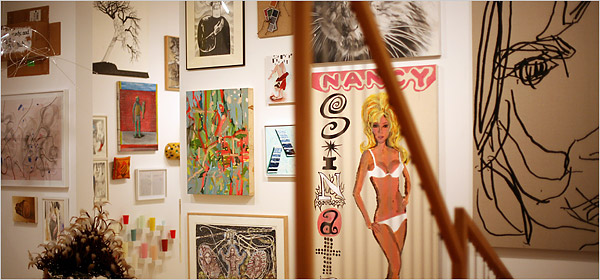
Artists make great exhibition curators. They have expert eyes, a personal stake in the game and contacts with all kinds of other artists, including those who ride under the establishment radar. Museum surveys of contemporary art rarely produce surprises. Artist-organized gallery shows almost always do.
And “NeoIntegrity” at Derek Eller Gallery does. Put together — amassed is the word — by the painter Keith Mayerson, it’s striking for its size alone. With pieces by about 190 artists in a space the size of a modest one-bedroom apartment, it’s the biggest little show of the summer — one of the most eclectic and one of the best.
In planning it Mr. Mayerson ransacked his address book and memory bank. He called on friends, neighbors, lovers, ex-teachers, past and present students, close colleagues and others he knew only from afar. If a certain painting knocked him out on a routine studio visit a decade ago, chances are that it, or something like it, is here.
This archival approach encompasses well-known figures (Nayland Blake, Ross Bleckner, James Siena) and those fresh on the scene. Age is not a selection factor: Ed Clark and Jane Freilicher, with decades-long careers, rub shoulders with newbies. And although painting is dominant, there is a lot more to see. Scott Hug and Michael Magnan deliver a patriotic pizza box; Sam Gordon an episodic video; and Hiroshi Sunari a ginko sapling grown from seeds that survived the atomic bombing of Hiroshima.
Variety is the bottom line, and one would expect no less from Mr. Mayerson, an artist of multifarious accomplishments. He made his New York debut in a 1994 group show with a virtuosic book-length sequence of cartoon drawings about Pinocchio. It was fantastic, and his fans were expecting more of the same in his solo debut at Jay Gorney three years later; instead they got woozy paintings of rainbows and gurus.
Then he was in and out of sight for several years, teaching at New York University. In 2003 Eller gave him a big-small solo — many paintings, tiny room — of brushy, jaundice-toned pictures loosely related to a “Hamlet” theme. Last season at Eller Mr. Mayerson did a portrait show of his heroes: Judy Garland, John Lennon, Audrey Hepburn, Jimi Hendrix, Bugs Bunny, Andy Warhol and Arthur Rimbaud. It was great. It had a kind of Rembrandt-Andy feel, soulful old master meets Pop queer. It was serious and funny at the same time.
The same can be said for “NeoIntegrity,” beginning with its title. Mr. Mayerson explains in a gallery news release that when he was given the go-ahead for the group show, he decided to take the opportunity to start an art movement. He even wrote a position paper for it, “The NeoIntegrity Manifesto.”
On the one hand the whole business is send-up, a joke. Movements are a thing of the past, when there was one kind of art and another kind, and that was it. Now there’s so much of so many things that nothing can or needs to be defined. Mr. Mayerson has always been very pro-muchness as an artist, thinker and curator. He embraces it, which is what makes his work feel generous, makes wherever he takes it feel right.
Some would say that integrity as a moral quality is also a thing of the past, with the art world swimming in money, pumping out product, ignoring conflicts of interest and so on. Mr. Mayerson’s response is not to scold but to ask, “What to do?” Hence the manifesto, an 11-point declaration that defines art as a humanist endeavor. But each definition comes with a modifying, even contradictory statement. Art should reflect the artist; art should reflect the culture. Art should not be a commodity; but if it is, that’s O.K.
In the end there’s something here for almost everyone to accept or reject. This is the muchness factor in operation again. One definition of integrity is, after all, wholeness, completeness, taking it all in. And taking it all in, artwise, is what Mr. Mayerson’s show is about.
You want still-life painting? Ingrid Arneberg and Ann Craven paint pretty flowers. Steve Balkin, Hugh Van Dusen and Neil MacDonald do landscapes. Portraiture accounts for a large slice of material. Although some sitters are not identified — Marvin Mattelson paints an “Eric,” Enoc Perez a “Carole,” Kelley Walker a gondolier — a tip toward celebrity faces is pronounced. In addition to Kathe Burkhart’s likeness of Elizabeth Taylor and Eric Doeringer’s of Elizabeth Peyton, you’ll find Kembra Pfahler captured by Travis Hutchins; Jane Fonda by Carol Bove; and a sensational full-length Nancy Sinatra by Stephen Tashjian, the artist known as Tabboo!
A few portraits are more naughty than nice. Neither the self-pleasuring “Christian” in a Billy Sullivan painting nor the snout-nosed sitter in Matt Borruso’s “Magenta” is destined for the National Portrait Gallery.
Design is art-world fashionable at present, and you’ll find examples here: a ceramic pot by Renee So, a fabric swatch collage by Chris Bogia (very nice), and three player pianos grafted together, courtesy of Dan Knapp. But perhaps the most intriguing category is the one corresponding to the “sublime,” an aesthetic term that Mr. Mayerson uses with unqualified enthusiasm in his manifesto.
It’s hard to say exactly what he means by it. Exquisite workmanship? Andrew Milan’s “American Flag,” Jessie Mott’s “Hamster” and Pam Lins’s “Polar Bear Painting” all qualify, as does the contribution of several of the show’s awesomely polished cartoonists, Nick Bertozzi, Brendan Burford and Matt Madden among them.
Then there are a few “spiritual” images, like an exquisite colored pencil drawing by Lorenzo De Los Angeles that gives a plate of spaghetti and meatballs a Last Supper glow, though we move into iffy, jokey territory here.
We seem to be light years away from sublime in Anne Collier’s “Real Life Experiences of Big Breasted Women” and Keith Boadwee’s exhibitionistic “Breakfast in America.” But are we? We’re certainly far from museum-land, as Ms. Collier’s indelicate photo-appropriation is unlikely ever to see the inside of MoMA, and even the liberal Whitney would balk at the Boadwee. Still, if their work is unacceptable to institutional taste, unacceptable defines an above-it-all sublime of its own.
Mr. Mayerson obviously understands this and with relish integrates the unacceptable into his new art movement. His exhibition concept is less a concept than a happenstance placing of this object next to that one, and these across from those. His main concern, you sense, was that there be room enough for everything, the “everything” brought together by his eye, his passion and his memory. This is a group show version of the all that is his art.